
Boswellia: The Inflammation Pathway Your Painkiller Doesn’t Touch

You take more ibuprofen than you’d like to. Most people with aching knees do, and most of them carry the same low-grade unease about it. Maybe your doctor has mentioned your stomach, or your blood pressure. Or maybe you’ve read enough on your own to be wary of taking something daily for the next twenty years.
Those drugs work well on one kind of inflammation, and they were never built to touch the other kind. Your body has two separate assembly lines for inflammatory signals, and the entire category of common anti-inflammatories works on one line while the other runs at full speed.
Boswellia works on the line they miss. That’s why it adds something rather than duplicating what you’re already doing, and it’s why an independent group comparing seven joint supplements put it at the top.
What It Is
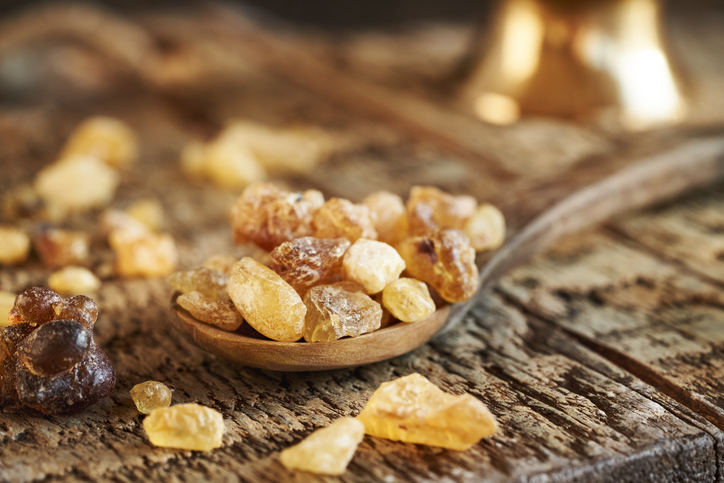
Boswellia serrata is the resin of a tree that grows in the dry hills of India, and you already know its cousins. This is frankincense: the same family of aromatic resins traded across the ancient world and burned in temples for three thousand years.
In Ayurvedic medicine the resin is called salai guggul, and it’s been used for swollen, painful joints for centuries. That history doesn’t prove it works, but a few thousand years of use is a reasonable sign that it’s well tolerated.
What’s new is knowing which compound in the resin does the work, and how to get a useful amount of it into your bloodstream. The second part matters enormously.
The Route Your Painkiller Doesn’t Touch
Your body builds inflammatory signals along two separate pathways.
The first produces compounds called prostaglandins. That’s the line ibuprofen, naproxen, and aspirin shut down, and it’s why they work as well as they do for a headache or a sprain.
The second produces compounds called leukotrienes, and the common anti-inflammatories leave it essentially alone. Boswellia’s active compound works on that second line.
So boswellia isn’t doing the same job at a different dose. It’s covering ground the other approach doesn’t reach, which is a different proposition from taking a stronger version of what you already take.
Turmeric is worth a word here, since it’s the usual alternative. It works on several inflammatory targets and the prostaglandin line is one of the main ones, so it overlaps with an anti-inflammatory more than most people realize. That doesn’t make turmeric useless. It does mean turmeric plus ibuprofen is less of a two-pronged strategy than it looks.
Why the Form Matters More Here Than Almost Anywhere
If you take one practical thing from this article, take this.
Boswellia resin contains several related compounds called boswellic acids. The one that appears to do most of the work is usually abbreviated AKBA, and generic extracts absorb it poorly. You can take a large dose of a cheap extract and deliver almost none of the compound that matters.
The form used in the clinical research is built around that problem. It’s standardized for AKBA content, and it’s blended back with boswellia’s own oils, which help carry the active compound across the gut wall. In rats, that blend raised blood levels of AKBA by about half compared with a more concentrated conventional extract [7].
The surprising part, and the most useful thing in this article: in a 90-day trial in people with knee osteoarthritis, the absorption-enhanced form outperformed a conventional extract standardized to a higher AKBA percentage [6]. Concentration lost to absorption. A 2024 analysis of nine trials found the enhanced form ahead of other boswellia extracts by two to three times on pain measures [3]. An independent 2025 network analysis of 20 trials landed in the same place: the absorption-enhanced formulations were the ones that improved pain, stiffness and knee function [2].
What to look for on a label: a named, standardized extract with published human trials behind it. What not to do is shop for the biggest AKBA number, because in this evidence the higher-percentage extract is the one that lost.
What the Research Shows
It works fast. In a 30-day trial of 60 people with knee osteoarthritis, 100 mg daily improved pain and function scores by day 5, with stiffness down about 40 percent against placebo by day 30 [5].
It outranked six other supplements. A 2025 analysis pooled 39 randomized trials in 4,599 patients and compared seven joint supplements against placebo: boswellia, curcumin, collagen, ginger, krill oil, vitamin D, and eggshell membrane. Boswellia came out first for pain and first for stiffness [1].
Cartilage, not only comfort. In a six-month trial of 80 people with knee osteoarthritis, researchers imaged the joint directly and found the supplemented group maintained cartilage thickness and joint space while the placebo group’s continued to thin [8]. That’s one trial and nobody has repeated it, so treat cartilage maintenance as encouraging rather than settled.
When a separate independent analysis pooled every boswellia form together, generic and enhanced alike, the overall effect washed out, though its placebo-controlled comparison still showed benefit [4]. That’s the form problem showing up in the data, and it’s the strongest argument there is for caring which extract you buy.
How It’s Different From What You’ve Already Tried
| Anti-inflammatory drugs | Turmeric / curcumin | Boswellia (enhanced form) | |
| Main inflammatory route | Prostaglandin | Several, prostaglandin among them | Leukotriene |
| Daily amount | Varies by drug | 500 to 1,500 mg | 100 mg |
| Long-term use | Stomach, kidney and cardiovascular concerns [1,4] | Generally well tolerated | Generally well tolerated |
| Cartilage evidence | No evidence of benefit | Limited | One six-month imaging trial |
Look at the top row. Boswellia is the only widely available joint ingredient working primarily on the pathway everything else mostly leaves alone, and that’s what makes it additive instead of redundant. If you’ve already got one route covered, covering the other is the obvious next move, not doubling down on the first.
What You Can Expect
Boswellia supports joint comfort, mobility, and a balanced inflammatory response. Based on what the trials in people with knee osteoarthritis measured, and what I saw clinically, that tends to show up as:
- Noticeably more comfortable joints within the first week or two, faster than most joint ingredients manage
- Easier movement through activity, with less of the flare after a demanding day
- More confidence planning your week around what you want to do instead of around your joints
- Support that builds with consistent daily use
On timing, this is the quick one. Most people who respond notice something inside two weeks, and 30 days is a fair test.
What I Saw in Practice
In 15 years of clinical practice I worked with thousands of patients, and one case captures why I keep coming back to this ingredient.
A former competitive tennis player in his early fifties had largely stopped playing because of knee discomfort. He’d tried the usual things without much success, and what he wanted back wasn’t a lower number on a pain scale. He wanted Saturday mornings on a court.
We added boswellia at 100 mg a day alongside the rest of what he was doing, which included getting serious about strength work for the first time in years. He noticed a difference in comfort inside the first week, and by three months he was playing regularly again and recovering faster between sessions.
What he told me at the end of it was that he’d stopped planning his week around his knees. That’s a better outcome than any questionnaire captures.
Dose, Timeline, and Real Cautions
One hundred milligrams daily of a standardized, absorption-enhanced extract is the studied dose. Generic boswellia at 100 mg won’t deliver a comparable amount of active compound, and that’s the whole reason the form section is in this article.
This ingredient has more meaningful interactions than most, so read this part properly. Boswellia has mild blood-thinning activity, so talk to your doctor before combining it with warfarin or any other blood thinner, and that includes daily aspirin. It may interact with medications processed by certain liver enzymes, which covers a lot of common prescriptions. Avoid it during pregnancy. Mild digestive upset is the most common complaint, and taking it with food usually handles that.
And since this article opened on your ibuprofen: nothing here is a reason to change how you take a medication. If you’re using an anti-inflammatory regularly, that’s a conversation to have with your doctor rather than a decision to make after reading an article.
Where to Find It
Fluid Motion is the joint formula I created for Adapt Naturals, the supplement company I founded. It provides 100 mg of AprèsFlex boswellia, the standardized absorption-enhanced form used in the research, alongside eggshell membrane and native type II collagen, which support joint comfort and mobility through separate pathways. One capsule a day, third-party tested, with a 90-day money-back guarantee. It contains eggshell membrane, so it isn’t suitable for anyone with an egg allergy.
Final Thoughts
People were using this resin for swollen joints long before anyone knew what inflammation was, working entirely from observation. What the modern research adds isn’t confirmation so much as precision: we now know which compound does the work, which pathway it acts on, and why one preparation delivers it and another doesn’t.
That last part is the practical catch. The tree doesn’t standardize its own resin, so what you buy determines whether you get any of this at all. Look for a named, standardized, absorption-enhanced extract with human trials behind it, and don’t let a big number on the front of the bottle stand in for that.
In health, Chris
These statements have not been evaluated by the Food and Drug Administration. This product is not intended to diagnose, treat, cure, or prevent any disease.
References
- Zhang, Y., Gui, Y., Adams, R., Farragher, J., Itsiopoulos, C., Bow, K., Cai, M., & Han, J. (2025). Comparative effectiveness of nutritional supplements in the treatment of knee osteoarthritis: A network meta-analysis. Nutrients, 17(15), 2547. https://doi.org/10.3390/nu17152547
- Inprasit, C., Bunyamahote, S., Boonpattharatthiti, K., Thimkorn, P., Intakhiao, S., & Dhippayom, T. (2025). Evaluating the efficacy and safety of Curcuma longa, Boswellia serrata, and their mixed formulation in treating knee osteoarthritis: A systematic review and network meta-analysis. Complementary Therapies in Medicine, 96, 103256. https://doi.org/10.1016/j.ctim.2025.103256
- Dubey, V., Kheni, D., & Sureja, V. (2024). Efficacy evaluation of standardized Boswellia serrata extract (Aflapin) in osteoarthritis: A systematic review and sub-group meta-analysis study. Explore, 20(5), 102983. https://doi.org/10.1016/j.explore.2024.02.001 (Authors affiliated with an industry sponsor.)
- Dalmonte, T., Andreani, G., Rudelli, C., & Isani, G. (2024). Efficacy of extracts of oleogum resin of Boswellia in the treatment of knee osteoarthritis: A systematic review and meta-analysis. Phytotherapy Research, 38(12), 5672–5689. https://doi.org/10.1002/ptr.8336
- Vishal, A. A., Mishra, A., & Raychaudhuri, S. P. (2011). A double blind, randomized, placebo controlled clinical study evaluates the early efficacy of Aflapin in subjects with osteoarthritis of knee. International Journal of Medical Sciences, 8(7), 615–622. https://doi.org/10.7150/ijms.8.615
- Sengupta, K., Krishnaraju, A. V., Vishal, A. A., Mishra, A., Trimurtulu, G., Sarma, K. V. S., et al. (2010). Comparative efficacy and tolerability of 5-Loxin and Aflapin against osteoarthritis of the knee: A double blind, randomized, placebo controlled clinical study. International Journal of Medical Sciences, 7(6), 366–377. https://doi.org/10.7150/ijms.7.366
- Sengupta, K., Kolla, J. N., Krishnaraju, A. V., Yalamanchili, N., Rao, C. V., Golakoti, T., et al. (2011). Cellular and molecular mechanisms of anti-inflammatory effect of Aflapin: A novel Boswellia serrata extract. Molecular and Cellular Biochemistry, 354(1–2), 189–197. https://doi.org/10.1007/s11010-011-0818-1 (Bioavailability measured in rats.)
- Kumar, B., Ghaytidak, A. B., Pandey, A. K., Somepalli, R. R., Sarda, P., Raychaudhuri, S. P., & Rokkam, M. P. (2025). A standardized Boswellia serrata extract improves knee joint function and cartilage morphology in human volunteers with mild to moderate osteoarthritis in a randomized placebo-controlled study. Journal of the American Nutrition Association, 44(5), 375–386. https://doi.org/10.1080/27697061.2024.2438894
- Park, D., Koh, H. S., Choi, Y. H., Moon, J. W., & Park, I. (2026). Reframing nutraceuticals in knee osteoarthritis with sarcopenia: A muscle-joint-centered narrative review. Nutrients, 18(12), 1871. https://doi.org/10.3390/nu18121871